Multi-level cascade fiber Bragg grating spectral simulation with apodization variations
DOI:
https://doi.org/10.59190/stc.v7i1.352Keywords:
Apodization, Cascade FBG, Fiber Bragg Grating, Optical Sensor, SimulationAbstract
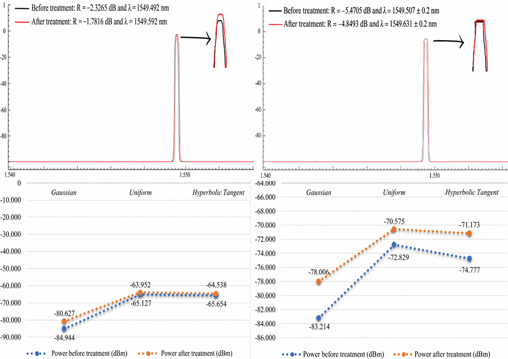
This paper presents a numerical investigation of the spectral characteristics of multi-level cascade fiber Bragg grating (FBG) structures employing Gaussian, uniform, and tangent hyperbolic apodization profiles. The analysis focuses on the combined influence of apodization function and cascade levels (4, 6, and 8 gratings) on Bragg wavelength shift, reflectivity stability, optical power distribution, and strain sensitivity. Simulation results demonstrate that Gaussian apodization provides superior spectral smoothness and wavelength stability across all cascade configurations, while tangent hyperbolic apodization exhibits the highest sensitivity to mechanical perturbation and maintains robust spectral integrity at higher cascade levels. In contrast, uniform apodization suffers from pronounced sidelobe effects, leading to spectral degradation as the number of cascaded gratings increases. These findings highlight the critical role of apodization selection in optimizing multi-level cascade FBG sensors for stable and sensitive multipoint sensing applications.
Published
How to Cite
Issue
Section
License
Copyright (c) 2026 Lily Tri Rachmawati, Saktioto Saktioto

This work is licensed under a Creative Commons Attribution 4.0 International License.