Explainable AI (XAI) for feature selection optimization in deep neural networks using the Howells craniometric dataset
DOI:
https://doi.org/10.59190/stc.v7i1.411Keywords:
1D-CNN, Explainable AI, Forensic Craniometry, GA-PSO, SHAPAbstract
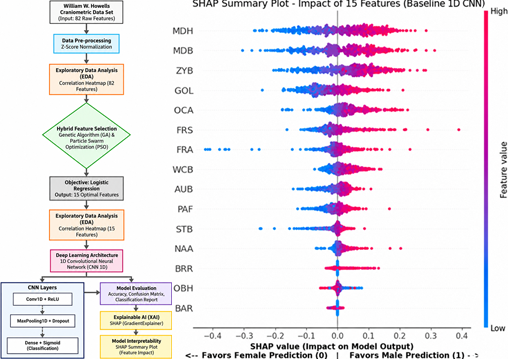
Biological profile identification through cranial metrics is a crucial procedure in forensic anthropology. The use of high-dimensional tabular craniometric data often triggers information redundancy problems that degrade the performance of computational models. Moreover, rejection in the medical and legal domains frequently occurs due to the black-box nature of Deep Learning algorithms, which fail to provide anatomical transparency. This research develops an advanced hybrid expert system framework for classification using craniometric data. In the pre-processing stage, feature selection is optimized using a hybrid approach of genetic algorithm (GA) and particle swarm optimization (PSO) to optimally extract 15 critical cranial parameters from the 82 raw features of the William W. Howells craniometric dataset. In the classification stage, a 1D convolutional neural network (1D-CNN) is constructed. To validate the effectiveness of the proposed method, the GA-PSO 1D-CNN model is compared against a baseline 1D-CNN model trained on all 82 raw features without feature selection. To overcome the transparency issue, the black-box nature of the model is dismantled using the explainable AI (XAI) method based on SHAP via GradientExplainer. The experimental results show that the GA-PSO optimization successfully reduces feature dimensionality deterministically, preventing the curse of dimensionality while maintaining classification precision. Furthermore, the visual SHAP analysis is able to present the hierarchy of the 15 most determining craniometric parameters, providing a rationalization of operational decisions that are cross-validated with the principles of human biological anatomy.
Downloads
Published
How to Cite
Issue
Section
License
Copyright (c) 2026 Surya Aditya GD, Robert Marco

This work is licensed under a Creative Commons Attribution 4.0 International License.