Phyto mediated of SnO2 nanoparticles using Pandanus amaryllifolius extract for photocatalytic degradation of methylene blue
DOI:
https://doi.org/10.59190/stc.v6i3.413Keywords:
Green Synthesis, Methylene Blue, Pandanus amaryllifolius, Photocatalyst, SnO2Abstract
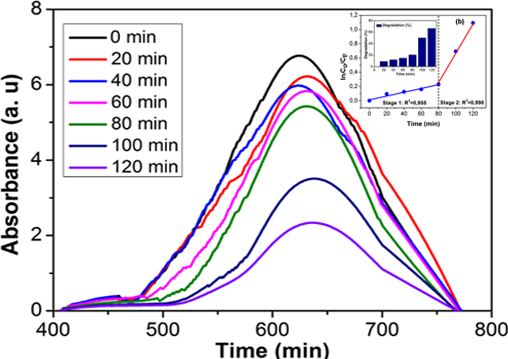
The development of environmentally friendly photocatalysts is crucial for the remediation of persistent textile dyes. This study reports a novel and simple green synthesis of ultrafine tin oxide (SnO2) nanoparticles by utilising Pandanus amaryllifolius leaf extract as a bioreductor and dual function capping agent, thereby eliminating the need for toxic chemicals and high energy calcination. Comprehensive characterisation confirmed the formation of a pure tetragonal rutile phase with ultrafine crystallite sizes of 4 – 5 nm. Importantly, surface interactions mediated by phytochemicals intrinsically engineer the optical band gap to 3.50 eV, much narrower than bulk SnO2 through the formation of defect states and mid-gap states, enhancing responsiveness to visible light. The photocatalytic efficacy was evaluated under challenging conditions using a high initial concentration of Methylene Blue (MB) (100 ppm). Green synthesised SnO2 nanoparticles exhibited robust degradation performance, achieving a removal rate of 66.5% within 120 minutes. Kinetic analysis reveals a characteristic two stage pseudo first order behaviour, indicating a transition from the initial induction phase to the formation of reactive oxygen species at steady state. This research provides new insights into the engineering of semiconductor defects mediated by phytochemicals and offers highly scalable sustainable nanomaterial strategies that align with green chemistry principles for industrial wastewater treatment.
Downloads
Published
How to Cite
Issue
Section
License
Copyright (c) 2026 Yanuar Yanuar, Tengku Emrinaldi, Rahmi Dewi, Lazuardi Lazuardi

This work is licensed under a Creative Commons Attribution 4.0 International License.