AI-based feature selection for craniometric sex classification: A nested cross-validation study on the Howells dataset
DOI:
https://doi.org/10.59190/stc.v7i1.420Keywords:
Feature Selection, Forensic Anthropology, Nested Cross-Validation, Sex Estimation, SHAPAbstract
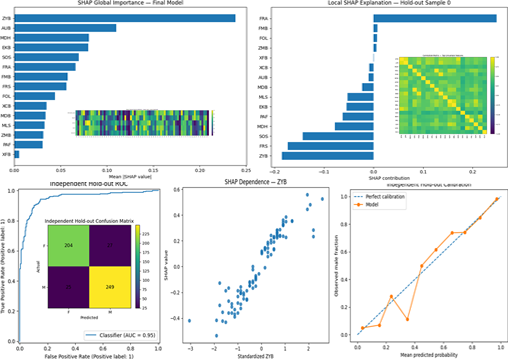
Sex estimation is an important part of forensic biological-profile reconstruction. However, machine-learning results can be overly optimistic when feature selection and hyperparameter tuning are performed without separating them from model evaluation. This study compared five feature-selection methods, namely Information Gain, ReliefF, LASSO, SHAP-based ranking, and support vector machine recursive feature elimination (SVM-RFE), using five classifiers: support vector machine (SVM), random forest, logistic regression, decision tree, and multilayer perceptron. The study used 2,524 individuals from a Howells-derived craniometric dataset, consisting of 1,156 females and 1,368 males. A stratified hold-out set containing 20% of the data was reserved before model development. After missingness filtering based on the development data, 71 predictors remained. Model development used 5-fold outer and 5-fold inner cross-validation, with 3, 5, 7, 10, and 15 candidate features. SVM-RFE combined with SVM obtained a nested-cross-validation accuracy of 0.8767 ± 0.0098, with an F1-score of 0.8852 and ROC-AUC of 0.9481. After retuning using the full development set, the final 15-feature model achieved 0.8970 accuracy, 0.9055 F1-score, 0.9511 ROC-AUC, 0.9088 sensitivity, and 0.8831 specificity on 505 internal hold-out observations. The AI-oriented selectors had a mean accuracy only 0.0074 higher than the filter selectors, which was below the predefined 0.05 improvement threshold. Classifier choice had a significant effect on accuracy, while the feature-selection method and its interaction with the classifier were not significant. SHAP analysis identified ZYB, AUB, and MDH as the three highest-ranked features. The results show that a relatively small number of craniometric features can provide good classification performance under the evaluation procedure used in this study. However, the differences between feature-selection approaches were relatively small, and further validation on independent populations and data collected at different time points is needed before the model can be considered for forensic use.
Published
How to Cite
Issue
Section
License
Copyright (c) 2026 Iis Afrianty, Liza Afriyanti

This work is licensed under a Creative Commons Attribution 4.0 International License.