Investigations of normalization strategies on [18F]-FDG pet radiomics feature: A multi-cancer analysis
DOI:
https://doi.org/10.59190/stc.v7i1.433Keywords:
[18F]-FDG PET, Cancer, Imaging, Normalization, RadiomicsAbstract
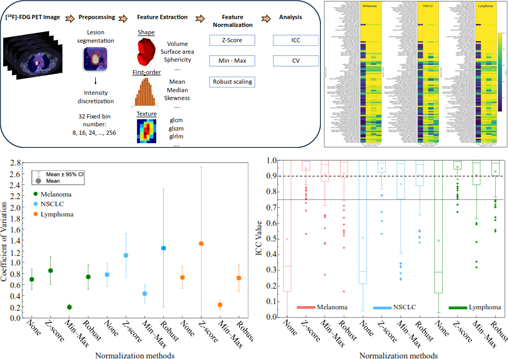
This study investigated the effects of normalization methods on the robustness of [18F]-FDG PET radiomic features across different fixed bin number (FBN) settings and cancer types. A total of 107 radiomic features were evaluated in melanoma, non-small cell lung cancer (NSCLC), and lymphoma datasets across 32 FBN settings ranging from 8 to 256 in increments of 8. Features were assessed without normalization and after Z-score, Min–Max, or Robust scaling, applied independently at each FBN setting. The intraclass correlation coefficient (ICC) was used as the measure of agreement across discretization settings, while the coefficient of variation (CV) was examined as a measure of variability. Normalization effects varied across radiomic feature classes and cancer datasets. Z-score and Robust scaling generally increased ICC for many texture features compared with no normalization, whereas the response to Min–Max scaling was more variable. CV distributions also differed across normalization methods and cancer types, with Z-score producing the highest mean CV and Min–Max the lowest in all three datasets. However, between-method differences in CV were interpreted descriptively, as normalization altered the feature means underlying its calculation and therefore limited direct comparability. Post extraction normalization was associated with increased ICC-based agreement of [18F]-FDG PET radiomic features across FBN settings, with Z-score normalization showing the most consistent results across cancer cohorts. However, the effects varied by feature and normalization method, highlighting the need for feature-level assessment and transformation-aware interpretation of variability.
Published
How to Cite
Issue
Section
License
Copyright (c) 2026 Vepy Asyana, Nanda Fitri Ayu Muningrat, Zulfa Zulfa, Feby Nur Sakinah, M Ikhsan, Defrianto Defrianto

This work is licensed under a Creative Commons Attribution 4.0 International License.