High-energy supercapacitor based on phosphoric acid (H3PO4)-activated Moringa oleifera leave waste as the electrode material
DOI:
https://doi.org/10.59190/stc.v7i1.436Keywords:
Activated Carbon, Electrode Material, Moringa oleifera, Supercapacitor, WasteAbstract
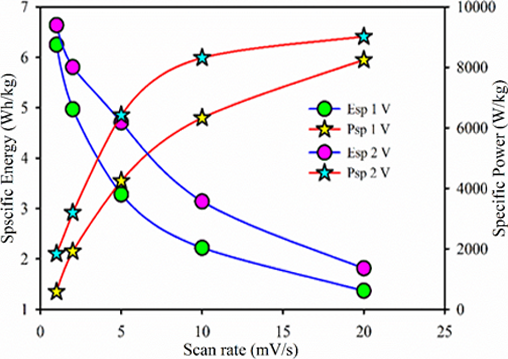
Moringa oleifera-leaves were used as the main starting material for making activated carbon for supercapacitor electrodes. The research focused on producing Moringa oleifera-leaves activated carbon and examining its physical properties and electrochemical performance. The activated carbon was produced through a chemical activation process using 0.5 M H3PO4, carbonization under N2 gas, and physical activation using CO2 gas. Density measurements showed a decrease from 0.94 g/cm3 to 0.60 g/cm3 following pyrolysis, representing a reduction of 36.17%. Electrochemical testing was performed using cyclic voltammetry (CV) and galvanostatic charge–discharge (GCD) methods in a 1 M Na2SO4 electrolyte with a current density of 1 A/g. Results obtained within a test voltage window of 0 – 1 V yielded specific capacitances of 45 F/g (CV) and 130 F/g (GCD). Further testing across a wider operating voltage window of 0 – 2 V resulted in a specific capacitance of 153.33 F/g, with a specific energy of 85.18 Wh/kg, and specific power of 1,840 W/kg. These findings demonstrate the potential of Moringa oleifera leaves waste for use as an electrode material in supercapacitors capable of operating at a voltage range of 0 – 2 V, thereby supporting the development of high-energy supercapacitors.
Downloads
Published
How to Cite
Issue
Section
License
Copyright (c) 2026 Salma Safitri, Fitriani Novalina Panjaitan, Novi Yanti, Nursyafni Nursyafni, Apriwandi Apriwandi, Rika Taslim, Erman Taer

This work is licensed under a Creative Commons Attribution 4.0 International License.